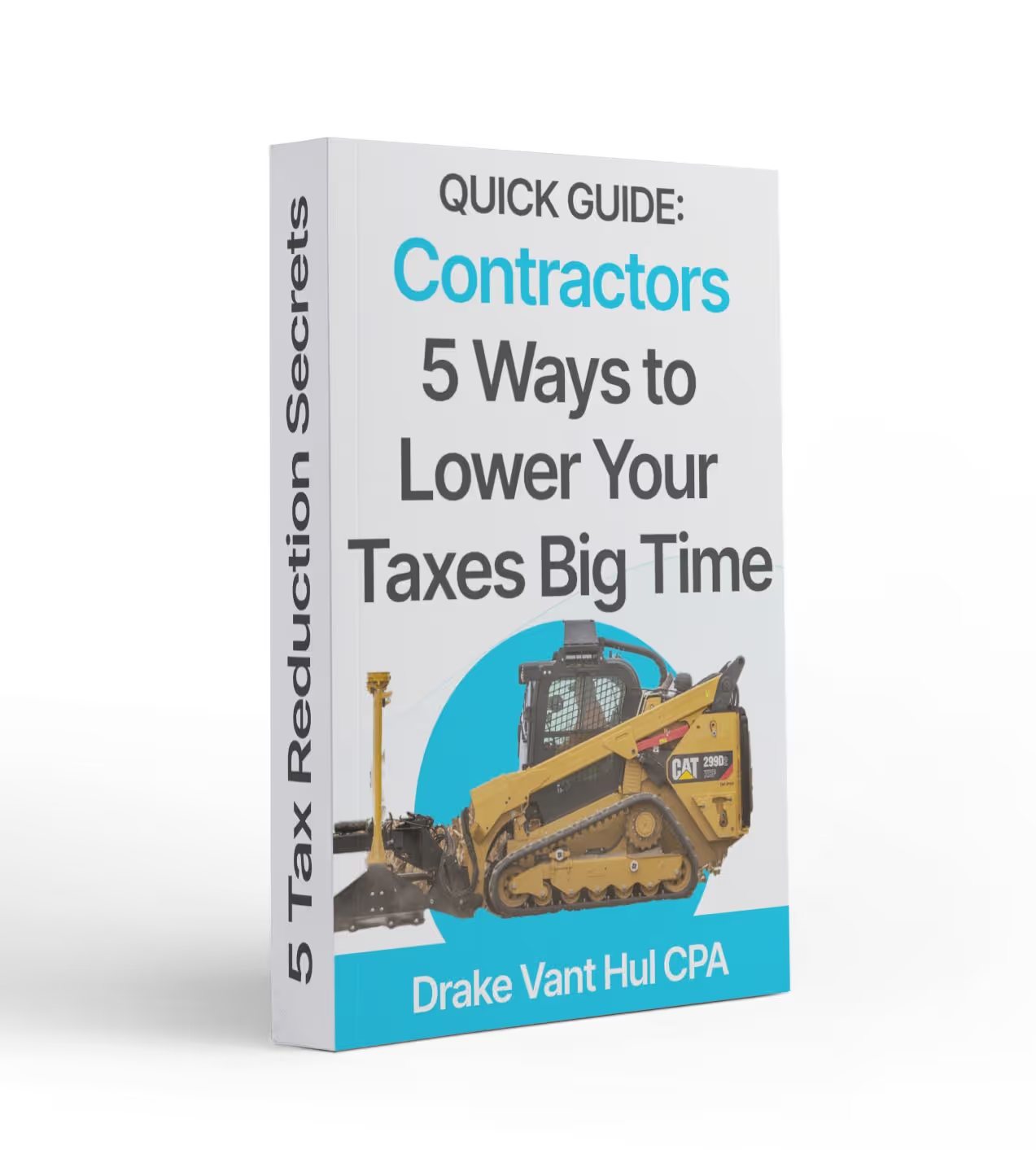
The worst part about taxes isn't writing the check to the IRS. It's not knowing what you're going to owe until it's too late.
Most contractors walk into tax season completely blind. They guess at their liability, hope for the best, and get slammed with a bill they didn't plan for. Then they scramble to find cash that should have stayed in their business, growing their operations instead of padding Uncle Sam's wallet.
Here's the truth: your tax bill should never be a surprise. And if you're working with a CPA who only talks to you once a year, you're leaving tens of thousands of dollars on the table.
At Performance Financial, we specialize in helping construction contractors, electricians, HVAC pros, and builders across Des Moines and the Midwest implement year-round tax reduction strategies that actually work. We don't wait until April to start planning. We build systems that save you money every single month.
Let me tell you about Clarence. He's a composite of dozens of contractors we've worked with over the years. Clarence came to us thinking he'd owe around $25,000 in federal taxes on his $75,000 income. Not bad for a self-employed contractor, right?
Wrong.
After one conversation, we found $20,260 in legitimate deductions he didn't even know existed. He walked out owing around $15,000 instead of $25,000. That's ten grand that stayed in his pocket, ready to invest back into his business, his equipment, or his family.
Here's exactly how we did it.
#1 - Business Mileage: The Deduction Hiding in Your Driveway
For 2021, the IRS gave contractors 56 cents per mile for business driving. Not commuting from your house to your shop—that doesn't count. But everything else? Fair game.
Driving to job sites. Running to the supply house. Meeting with clients. Stopping for materials. Checking on another crew's progress. Every single mile adds up faster than you think.
The problem? Almost nobody tracks it properly.
Clarence estimated he drove about 3,500 business miles during the year. Most contractors wildly underestimate this number because they're not tracking it in real time. They're guessing at the end of the year, trying to remember where they went and how often.
The math: 3,500 miles × $0.56 = $1,960 in deductions
That's almost two grand Clarence never had to pay taxes on, just for driving his truck to do his job. Money he was already spending on gas, maintenance, and wear-and-tear.
QuickBooks Online has built-in mileage tracking. There are dozens of mobile apps that automatically log your trips with GPS. You literally just tap a button when you leave, and it tracks everything for you. At the end of the year, you've got a detailed report ready for your CPA.
If you're not tracking mileage, you're hemorrhaging money. Period.
Example: BluPrint CPA, a Charlotte-based firm specializing in contractors, has built their entire practice around helping construction businesses maximize these commonly missed deductions. Their blog on landscaping tax write-offs walks through exactly how contractors in similar industries leverage mileage tracking to save thousands annually.
#2 - Home Office Deduction: You're Already Paying For It
Most contractors think the home office deduction doesn't apply to them because they work on job sites all day. Wrong.
If you're doing paperwork at home, storing equipment in your garage, keeping inventory in a shed, or meeting with clients in your home office, you qualify. The IRS gives you a simplified deduction: $5 per square foot, up to 300 square feet.
Clarence had a 20×10 space in his house he used exclusively for business. He'd meet with clients there, store inventory, handle all his paperwork and invoicing. That's 200 square feet.
The math: 200 square feet × $5 = $1,000 in deductions
This isn't cash out of pocket. You're already paying for your house, your electricity, your internet. The IRS is saying, "Hey, we know part of your home is dedicated to running your business, so we'll give you a break for it."
It's free money for space you're already using.
Now, some contractors have more complex situations—maybe a large shop building on their property or extensive equipment storage. In those cases, we might calculate actual expenses instead of using the simplified method. It depends on your specific situation, which is exactly why you need a CPA who understands construction accounting.
Example: Passageway Financial, a Minneapolis firm working with contractors and landscapers, details how home office deductions work specifically for businesses in the trades. Their approach to helping clients in Brooklyn Park and St. Paul mirrors what we do here in Des Moines—finding every legitimate deduction available.
#3 - Cell Phone and Internet: Stop Paying Personally for Business Expenses
You can't run a contracting business in 2025 without a cell phone and internet. Clients call you. You send estimates. You coordinate crews. You manage your website and social media marketing. You handle invoicing and payments.
These aren't personal expenses—they're business necessities.
Yet most contractors pay for them out of their personal accounts, never thinking to write them off. That's a mistake that costs you hundreds, sometimes thousands, every year.
Clarence paid $150 per month for internet and his phone plan. He needed both to run his business. That's it—no complicated calculation needed.
The math: $150 × 12 months = $1,800 in deductions
If you've got a family plan and only part of it is for business, we can parse out just your portion. If you've got dedicated business lines, even better—those are 100% deductible.
The key is moving these expenses onto your business accounts where they belong. Your bookkeeping system should be tracking these as business expenses, not personal spending.
Example: Wiggs CPA in Chicago has built an entire resource around the biggest write-offs contractors miss. Their focus on home service businesses shows how even basic expenses like cell phones can add up to significant tax savings when properly categorized.
#4 - Pre-Paying Bills: Strategic Year-End Tax Moves
Here's a strategy most contractors never hear about: pre-paying expenses to accelerate deductions.
Most small businesses and contractors under $25 million in annual revenue are cash basis taxpayers. This means you get to deduct an expense in the year you actually pay it, not when you incur it.
So if your insurance agent calls in November and says, "Hey, next year's policy is $2,000, and if you pre-pay now, I'll give you a $500 discount," you should seriously consider it—especially if you've had a profitable year.
Clarence's insurance agent made exactly that call. Clarence paid $2,000 in November for the following year's insurance coverage. From a bookkeeping perspective, that's a prepaid expense that gets amortized over the next year. But from a tax perspective? He gets to deduct the full $2,000 in the current year.
The math: $2,000 pre-payment = $2,000 in current-year deductions
This strategy works for any service you know you'll need: insurance policies, equipment leases, maintenance contracts, subscriptions, professional dues. If you've got the cash available and you've had a profitable year, strategically pre-paying expenses can significantly reduce your current-year tax bill.
The key word here is "strategic." You don't want to pre-pay everything just for the deduction if it hamstrings your cash flow. This is where working with a construction-specialized CPA throughout the year makes all the difference.
Example: Surety CFO focuses exclusively on construction contractors and details how year-end tax planning—including strategic pre-payments—can dramatically reduce tax liability. Their construction job costing expertise helps contractors understand not just tax implications but overall financial strategy.
#5 - Retirement Plan Contributions: Build Wealth While Cutting Taxes
Most contractors think retirement planning is something they'll worry about "someday." Meanwhile, they're missing one of the most powerful tax reduction strategies available.
For 2021, business owners can contribute up to $58,000 to retirement accounts, or 25% of net income, whichever is less. These contributions are fully deductible.
Think about that for a second. You're putting money away for your future, letting it grow tax-free, AND you're getting a deduction today that lowers your current tax bill.
Clarence had been putting $1,000 per month into a retirement account, but he thought it was just personal savings coming out of his paycheck. When we showed him that these contributions could be structured as business deductions through a SEP IRA, his eyes lit up.
The math: $1,000 × 12 months = $12,000 in deductions
This isn't complicated or expensive to set up. A SEP IRA has minimal fees and can be opened at almost any financial institution. You can contribute whenever you want throughout the year, and you get to decide each year how much to put in based on your profitability.
If you're making six figures and not maxing out retirement contributions, you're paying way more in taxes than you should be. We help contractors implement retirement strategies that make sense for their specific situation, whether they have employees or not.
Want to understand how this works for your business? Book a Tax Reduction Analysis with our team, and we'll show you exactly how much you could be saving.
Example: Tax Plan Ventures walks through eight specific tax mitigation strategies that business owners need to implement, including retirement account optimization. Their focus on proactive tax planning rather than reactive compliance mirrors our approach at Performance Financial.
#6 - S Corp vs Sole Proprietor: The Self-Employment Tax Killer
This is the big one. The strategy that can save contractors $10,000, $20,000, even $50,000+ per year depending on their income level.
When you're self-employed as a sole proprietor or single-member LLC, you pay self-employment tax on all your net income. That's 15.3% right off the top—7.65% that you would normally pay as an employee, plus another 7.65% that your employer would normally pay.
But when you're self-employed, you get to pay both halves. Lucky you.
An S Corporation changes the game entirely. With an S Corp structure, you take a reasonable salary (which is subject to payroll taxes), but the remaining profit passes through to you as distributions, which are NOT subject to self-employment tax.
Let's say you net $100,000 as a sole proprietor. You're paying $15,300 in self-employment taxes.
Now let's say you convert to an S Corp, take a $60,000 salary (reasonable for your industry and role), and the remaining $40,000 comes to you as distributions. You're only paying self-employment taxes on the $60,000 salary, saving you $6,120 in taxes on that $40,000 in distributions.
Scale that up as your income grows, and the savings become massive.
Clarence wasn't ready to make the S Corp switch yet—he was still doing most of the work himself and didn't have systems in place to support the added complexity. But we had the conversation, so when he does have employees and scalable systems, he knows exactly what to do.
If you're netting over $60,000 per year, you should be seriously considering an S Corp election. And if you're over $100,000, you're almost certainly losing money by staying a sole proprietor.
Not every contractor is ready for an S Corp—there are additional compliance requirements and costs—but for the right business at the right stage, it's the single most effective tax reduction strategy available.
Example: Makh Accounting, working with roofers and construction contractors in Texas, provides detailed guidance on how contractors can structure their businesses for maximum tax efficiency. Their S Corp vs LLC resource breaks down exactly when it makes sense to make the switch.
Another excellent example is Whyte CPA in Phoenix, which serves construction contractors and landscapers across Arizona. They detail the specific scenarios where S Corp status delivers the most value, particularly for contractors in Phoenix, Scottsdale, and surrounding areas.
Putting It All Together: Clarence's $10,000 Tax Savings Breakdown
Let's recap what we found for Clarence in one conversation:
- Business Mileage: $1,960 in deductions
- Home Office: $1,000 in deductions
- Cell Phone & Internet: $1,800 in deductions
- Pre-Paid Insurance: $2,000 in deductions
- Retirement Contributions: $12,000 in deductions
Total Additional Deductions: $18,760
Clarence originally thought he'd owe around $25,000 in federal taxes. After identifying these deductions, his liability dropped to approximately $15,000.
That's a $10,000 tax savings from strategies he didn't even know existed. Money that stayed in his business instead of going to the IRS.
And here's the kicker: this wasn't some aggressive, borderline-legal tax scheme. These are completely legitimate, IRS-approved deductions that contractors are entitled to claim. Clarence was just leaving them on the table because nobody had explained them to him.
Why Most CPAs Miss These Deductions
Generic CPAs aren't equipped to find these opportunities. They're trained in basic tax compliance—collecting your information, plugging numbers into software, and filing your return. They ask, "What's your income?" and "What are your expenses?" Then they process the paperwork and send you a bill.
That's not tax planning. That's data entry.
At Performance Financial, we do things differently. We ask deeper questions:
- How many miles did you drive for business?
- What space in your home do you use exclusively for work?
- Are you paying for your cell phone and internet personally?
- What bills could you strategically pre-pay before year-end?
- Are you maximizing retirement contributions?
- Is your business structure optimized for tax efficiency?
We don't wait until April to start this conversation. We're talking about these strategies in monthly meetings, quarterly reviews, and year-round planning sessions. Because tax planning isn't a once-a-year event—it's an ongoing process.
Our clients in Des Moines, Ankeny, West Des Moines, and across Iowa don't get tax surprises. They know exactly what they'll owe, when they'll owe it, and how to minimize it legally.
The Performance Financial Difference for Construction Contractors
We specialize in working with construction contractors, general builders, electricians, HVAC contractors, plumbers, and other trades professionals because these businesses have unique accounting needs that generic CPAs don't understand.
You're not just tracking revenue and expenses. You're managing:
- Job costing across multiple projects
- Equipment depreciation schedules
- Subcontractor payments and 1099 reporting
- Progress billing and retention holdbacks
- Work-in-progress schedules
- Seasonal cash flow fluctuations
- Employee vs. contractor classifications
This isn't Accounting 101 stuff. It requires specialized knowledge, industry-specific systems, and year-round engagement.
That's what we deliver.
When you work with Performance Financial, you get:
1. Industry-Specific Expertise
We understand construction accounting inside and out. We know the deductions available to contractors. We know how to structure your books for maximum tax efficiency. We know the questions to ask that generic CPAs miss.
2. Year-Round Tax Planning
We don't talk to you once a year and disappear. We're engaged throughout the year, helping you make strategic decisions, tracking your progress toward goals, and adjusting strategies as your business grows.
3. Proactive Communication
We reach out to you—not the other way around. Monthly meetings. Quarterly reviews. Strategic planning sessions. You're never wondering where you stand financially or what your tax situation looks like.
4. Systems That Scale With You
Whether you're a one-person operation or running multiple crews, we build accounting and bookkeeping systems that grow with your business. When you're ready to expand, hire more people, or take on bigger projects, your financial infrastructure can handle it.
5. Strategic Business Guidance
We're not just number crunchers. We help you understand your most profitable types of work, identify underperforming projects, manage cash flow through seasonal fluctuations, and build a business that runs without you.
This is what separates us from the $300-per-return tax preparers and the generic accounting firms that treat contractors like any other business.
You can see what other contractors say about working with us on our reviews page.
Don't Leave Money on the Table
Clarence's story isn't unique. We have these conversations with contractors all the time. Smart, successful business owners who are paying way more in taxes than they should because nobody's shown them what's possible.
Maybe you're tracking mileage but missing the home office deduction. Maybe you're writing off your cell phone but not pre-paying strategically. Maybe you're making six figures as a sole proprietor when you should be running an S Corp.
Every single one of those missed opportunities is money leaving your business unnecessarily.
The worst part? You'll never know what you're missing until you sit down with someone who actually knows construction accounting. A generic CPA will take what you give them, process your return, and send you a bill. They won't dig deeper. They won't ask better questions. They won't find the thousands of dollars in savings that are hiding in plain sight.
At Performance Financial, finding those savings is literally what we do.
If you're a contractor, electrician, HVAC professional, plumber, or builder in Iowa, Nebraska, or the Midwest, and you're tired of overpaying taxes because your CPA doesn't understand your business, let's talk.
Book a Tax Reduction Analysis with our team. We'll review your current situation, identify opportunities you're missing, and show you exactly how much you could be saving.
Because the worst part about taxes isn't paying them. It's paying more than you have to because nobody showed you a better way.
Additional Resources for Contractors
Want to dive deeper into tax strategies and growth tactics for construction businesses? Check out these resources:
- 6 Best Tax Write-Offs for Your Small Business
- 10 Amazing Tax Write-Offs Every Small Business Owner Needs to Know
- Self-Employment Taxes: What You Need to Know
- S Corp vs LLC for Painting Contractors
- 13 Tax-Saving Strategies for Iowa Custom Home Builders
Looking for more specialized guidance? Check out these industry-specific resources from firms doing similar work:
- Complete Balance CPA focuses on nonprofit accounting but also helps small businesses implement proactive tax strategies with their outsourced accounting services.
- Golden Tax & Accounting Co. serves contractors across San Diego, with specialized services in Carlsbad and Oceanside.
- AJ Financial LLC provides small business tax guidance, with particularly useful insights in their article on recordkeeping for businesses.
For marketing and business growth strategies, Feedbackwrench specializes in helping contractors build online presence and generate leads through strategic digital marketing.
Get Started Today
Ready to stop overpaying and start keeping more of what you earn?
Schedule Your Tax Reduction Analysis Now
Or call us directly to discuss how we can help your construction business pay less in taxes and keep more of your hard-earned profits.
Performance Financial CPA, Accounting & Tax
Serving Construction Contractors Across Des Moines, Iowa & the Midwest
Specializing in:
Don't let another year go by leaving thousands of dollars on the table. Your business deserves better. Your family deserves better. And honestly, you deserve a CPA who actually understands what you do and how to help you succeed.
Let's make it happen.
Schedule a Tax & Accounting Analysis Now
Step 1 - Fill out the form below.
Step 2 - Select a time.
Step 3 - Provide documents.