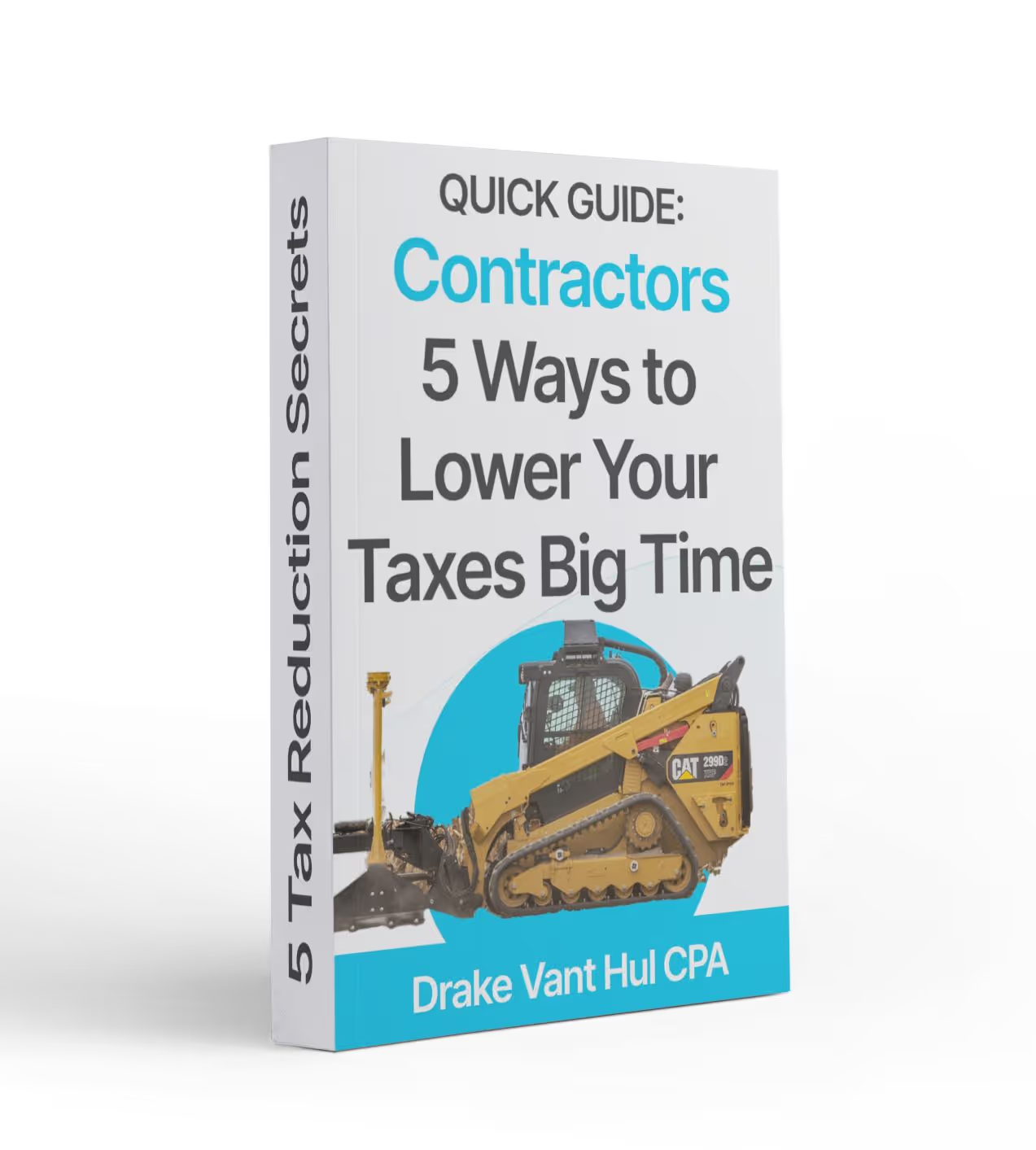
Most Des Moines contractors overpay taxes by $20,000-$75,000 annually. Not because they're cheating. Not because they're careless. Because they're working with accountants who treat construction businesses like retail shops.
Generic accountants miss construction-specific tax strategies. They file your return. They take standard deductions. They charge you a fee. And they send you a tax bill that's $50,000 higher than it needed to be.
Smart contractors don't work with generic accountants. They work with construction CPAs who understand equipment depreciation, entity structuring, and Iowa-specific opportunities that can save massive amounts of money.
Section 179: The $1.16 Million Immediate Write-Off Most Contractors Underutilize
Section 179 allows you to deduct up to $1.16 million (2024 limit) in equipment purchases in the year you buy them—instead of depreciating them over five, seven, or fifteen years.
What qualifies: excavators, skid steers, dump trucks, trailers, compactors and rollers, scaffolding and lifts, power tools and generators, office equipment and computers, job site trailers and storage, and construction software and technology.
The strategy most contractors miss: timing equipment purchases to match high-income years. If you're having a great year and facing a $75,000 tax bill in December, buying a $60,000 excavator before December 31 can save you $15,000-$20,000 in immediate taxes while giving you equipment you needed anyway.
But here's the catch: you have to actually need the equipment. Buying stuff you don't need just to save taxes is stupid. The smart play is coordinating your equipment replacement schedule with your tax situation to maximize deductions.
Example: A Des Moines excavation contractor had a $400,000 profit year. His generic accountant said, "You owe $95,000 in taxes." We looked at his equipment list and saw he'd been planning to replace two aging dump trucks next spring. We said, "Buy them in December instead."
He purchased $85,000 in trucks before year-end. Section 179 deduction saved him $22,000 in federal taxes plus $5,500 in Iowa state taxes. He needed the trucks anyway—we just timed the purchase strategically.
That's the difference between a generic accountant and a construction tax specialist. One files your return. The other builds a strategy.
Contractors like DMS Demolition and Plan Pools understand this. They're not buying equipment randomly. They're coordinating purchases with tax planning to maximize deductions.
Bonus Depreciation: The Additional Layer Most Contractors Don't Stack
Bonus depreciation allows you to write off a percentage of equipment costs immediately, even after maxing out Section 179. While the percentage has been phasing down (it was 100% through 2022, currently lower), it's still a valuable strategy for contractors with large equipment purchases.
Where bonus depreciation shines: purchases exceeding the Section 179 limit, used equipment (yes, used equipment qualifies), improvements to existing buildings, and land improvements like paving and grading.
The stacking strategy: Use Section 179 for your first $1.16 million in equipment, then apply bonus depreciation to additional purchases beyond that limit. For contractors doing $5M-$20M in revenue with significant equipment needs, this stacking can create $200,000-$500,000 in immediate deductions.
Real example: An Iowa commercial contractor bought $1.5 million in equipment in a high-income year. Section 179 covered the first $1.16 million. Bonus depreciation applied to the remaining $340,000. Combined federal and Iowa tax savings: $127,000.
Without strategic planning, he would have depreciated that equipment over five years, paying full taxes now and getting deductions later when they might not matter as much.
This is why contractors need proactive tax planning, not reactive tax filing. The savings aren't in the forms you file in April. They're in the decisions you make in July, September, and November.
The S-Corp Strategy: Saving $15K-$40K Annually on Self-Employment Taxes
Iowa contractors operating as sole proprietors or single-member LLCs pay self-employment tax on every dollar of profit. That's 15.3% on top of regular income taxes.
On a $200,000 profit, that's $30,600 in self-employment tax alone. On a $400,000 profit, it's $61,200. This is money you don't need to pay.
S-Corp election changes this. Instead of paying self-employment tax on all profit, you pay yourself a reasonable salary (subject to payroll taxes) and take the rest as distributions (not subject to self-employment tax).
Example calculation: Iowa contractor makes $350,000 profit. As a sole proprietor, self-employment tax is $53,550. As an S-Corp with a $120,000 reasonable salary, self-employment tax is $18,360. Annual savings: $35,190. Over ten years: $351,900.
That's not a small number. That's a lake house. That's your kid's college tuition. That's retirement security.
But here's the requirement: S-Corps require clean books. You can't run personal expenses through the business. You can't commingle funds. You need proper construction bookkeeping with accurate financial statements, documented transactions, and defensible salary justifications.
Contractors with sloppy books can't make the S-Corp election work. Contractors with sophisticated accounting systems can save massive money.
Companies like IBS Coating and Cascade Concrete Coatings demonstrate this. They're not winging it. They're running proper financial systems that enable tax-saving strategies.
Vehicle Depreciation: The Strategy That Changes With Every Tax Year
Construction companies use vehicles differently than other businesses. Trucks are tools, not transportation. This creates specific depreciation opportunities.
Current rules: trucks over 6,000 pounds gross vehicle weight have favorable depreciation, luxury vehicle limits don't apply to heavy trucks, Section 179 works for qualified vehicles, actual expense method often beats mileage for contractors, and vehicle choice impacts depreciation strategy.
Example: A contractor buys a $70,000 F-350 for business use. If it's over 6,000 pounds GVW and used more than 50% for business, he can potentially deduct the full $70,000 in year one using Section 179. That's a $19,000-$25,000 immediate tax savings depending on his bracket.
A $45,000 sedan? Subject to luxury vehicle limits, capped depreciation, stretched over multiple years. Big difference.
The planning angle: If you're buying vehicles anyway, understanding depreciation rules helps you choose which vehicles to buy and when to buy them. A 2500 series truck often qualifies for better tax treatment than a 1500 series. Timing matters. Vehicle weight matters. Business use percentage matters.
Generic accountants don't plan this. They depreciate whatever you bought. Construction CPAs help you make strategic vehicle decisions before you buy.
Equipment Trade-Ins: The Tax Trap That Costs Contractors Thousands
Here's a mistake we see constantly: contractors trade in old equipment when buying new equipment, thinking they're getting a good deal. They might be—but they're probably losing tax benefits.
Why trades hurt: when you trade equipment, you don't get to deduct the trade-in value immediately. It reduces the basis of the new equipment, stretching the tax benefit over years. Selling equipment outright often creates better tax outcomes.
Example: Contractor has a $30,000 excavator (fully depreciated). Dealer offers $15,000 trade-in toward a $90,000 new excavator. If he trades, he buys the new excavator for $75,000 net, losing the immediate tax benefit of the $15,000 trade value. If he sells the excavator for $15,000 separately and buys the new one for $90,000, he can potentially Section 179 the full $90,000, creating an immediate $24,000-$30,000 tax deduction.
The tax savings often exceed any dealer discount on the trade. But you need to run the numbers—and generic accountants don't run these numbers because they don't understand construction equipment transactions.
Home Office Deduction: The Legitimate Strategy Contractors Fear
Contractors avoid home office deductions because they've heard horror stories about audits. But if you legitimately use part of your home exclusively for business administration, you're leaving money on the table by not claiming it.
What qualifies: dedicated office space for bookkeeping, estimating, bidding, and administrative work. It must be exclusive business use and regular use. But if you're doing estimates, managing schedules, and handling administration from a home office, you qualify.
The deduction: proportion of mortgage interest, property taxes, utilities, insurance, maintenance, and depreciation based on square footage. On a $250,000 home with a 200-square-foot office in a 2,000-square-foot house, that's roughly $2,500-$4,000 in annual deductions. Over ten years: $25,000-$40,000.
The audit risk myth: properly documented home office deductions aren't audit magnets. What triggers audits are questionable deductions with no documentation. If you have photos of your office, business use logs, and clean separation from personal space, you're fine.
Retirement Planning: The Tax Strategy That Builds Wealth
Construction contractors in high-income years should maximize retirement contributions. Not just because retirement is important—because it's a massive immediate tax deduction.
SEP IRA: Contribute up to 25% of compensation or $69,000 (2024), whichever is less. Immediate tax deduction. On a $60,000 contribution, that's $16,000-$21,000 in tax savings depending on your bracket.
Solo 401(k): If you have no employees, you can contribute $23,000 as an "employee" plus up to 25% as "employer," potentially reaching $69,000 total. Same immediate tax savings.
Defined Benefit Plan: For contractors consistently making $300,000-$500,000+, defined benefit plans can shelter $150,000-$300,000 annually. This is nuclear-level tax planning, but it works for established contractors with sustained high income.
The strategy: High-income years trigger maximum retirement contributions. Lower-income years might trigger Roth conversions (paying tax now on retirement money when rates are low). This requires year-round tax planning, not last-minute December decisions.
Contractors like Garvin Homes and Legacy Painting aren't just building businesses. They're building retirement security through intelligent tax strategies.
Cost Segregation: The Advanced Strategy for Property-Owning Contractors
If you own your shop, warehouse, or office building, cost segregation can accelerate depreciation and create immediate tax deductions.
How it works: Instead of depreciating the entire building over 39 years (commercial) or 27.5 years (residential), cost segregation identifies components that can be depreciated faster. Flooring, electrical, HVAC, site improvements, and parking lots can often be depreciated over 5, 7, or 15 years instead of 39.
Example: $2 million commercial building. Standard depreciation: $51,000/year. After cost segregation study identifying $800,000 in accelerated components: $140,000+ in year-one deductions.
This strategy requires a cost segregation study (usually $5,000-$15,000) but can create $100,000-$500,000 in accelerated deductions depending on building value.
Who benefits most: contractors who purchased buildings in the past few years, contractors planning to purchase buildings, contractors with significant building improvements, and contractors in high-income years looking for additional deductions.
Work Opportunity Tax Credit (WOTC): Hiring Incentives Worth $2,400-$9,600 Per Employee
WOTC provides tax credits for hiring individuals from target groups including veterans, ex-felons, SNAP recipients, and long-term unemployment recipients.
The credit: $2,400-$9,600 per qualified new hire depending on the target group and hours worked. For a construction company hiring 5-10 new employees annually, this can be $12,000-$50,000 in annual tax credits.
The catch: You must apply for certification before or shortly after hiring. Most contractors don't because they don't know about it—or their generic accountant doesn't mention it.
Real example: Iowa HVAC contractor hired eight new technicians in a year. Four qualified for WOTC. Total credit: $18,400. His previous accountant never mentioned this program. We filed the certifications and got him the credit.
That's money he would have left on the table without a construction-focused CPA who understands hiring incentives.
The Completed Contract Method vs. Percentage of Completion: Choosing Your Accounting Method Strategically
Construction contractors can use different revenue recognition methods for tax purposes, and the choice impacts when you pay taxes.
Completed Contract Method: recognize all revenue and expenses when the project finishes. This can defer taxes if you have long-term projects completing in different years.
Percentage of Completion Method: recognize revenue and expenses proportionally as the project progresses. This creates more consistent income but less flexibility for tax planning.
The strategy: contractors under $25 million in average annual gross receipts have more flexibility in choosing methods. Strategic method selection can smooth income, defer taxes to low-rate years, and optimize cash flow.
This is advanced tax planning that requires understanding construction accounting and strategic thinking about multi-year tax situations. Generic accountants use one method for everyone. Construction CPAs choose the method that optimizes your specific situation.
Fuel Tax Credits: The Overlooked Deduction for Off-Road Equipment
Contractors using diesel fuel or gasoline in off-road equipment can claim fuel tax credits for the federal excise taxes paid on that fuel. Most construction equipment—bulldozers, excavators, generators—operates off-road.
The credit: varies based on fuel type and usage, but for contractors with significant off-road equipment, it can be $2,000-$10,000 annually. It's not huge, but it's also not complicated—and it's money you already paid that you can get back.
The requirement: tracking fuel usage between on-road and off-road equipment. This requires basic documentation, but it's worth the effort.
Strategic Tax Planning: Why Timing Matters More Than Tactics
All these strategies are useless if you're doing tax planning in March for the previous year. Tax planning is a year-round process.
What strategic contractors do: January - review previous year results, plan current year strategy, February/March - file returns, implement first-quarter strategies, April-September - monitor income, adjust quarterly estimates, evaluate mid-year opportunities, October-November - finalize equipment purchases, make retirement contributions, implement year-end strategies, and December - execute final decisions, document everything, close the year clean.
What reactive contractors do: March - scramble to file taxes. April - get surprised by tax bill. May-December - ignore taxes. January - panic. Repeat.
The difference is $30,000-$75,000 annually for most contractors doing $1M-$5M in revenue.
Companies like Red's Outdoor and CBC Twin Cities aren't doing tax planning once a year. They're working with CPAs who call them quarterly, review their numbers monthly, and plan strategically year-round.
The Cost of Generic Accounting
Here's what happens when you work with a generic accountant who doesn't understand construction:
They don't ask about equipment purchases until tax time (missed Section 179 timing). They don't evaluate S-Corp election (missed $25,000 in annual savings). They don't track vehicle depreciation properly (missed $8,000 in deductions). They don't plan retirement contributions strategically (missed $15,000 in tax-deferred savings). They don't identify WOTC opportunities (missed $12,000 in credits). They file your return cleanly and charge $2,500 (while costing you $60,000 in missed savings).
Your "cheap" accountant is the most expensive service provider you have. They're saving you $2,500 in fees while costing you $60,000 in missed opportunities.
Ready to Stop Overpaying Taxes?
If you're working with an accountant who only talks to you during tax season, you're leaving massive money on the table.
We work with construction contractors throughout Des Moines, Ankeny, West Des Moines, Waukee, and across Iowa to implement tax strategies that save $20,000-$100,000+ annually. We don't just file returns. We build strategic tax plans that integrate with your job costing, your cash flow, your equipment replacement schedule, and your long-term wealth-building goals.
Book a Tax Reduction Analysis and let's identify exactly how much money you're leaving on the table—and build the plan to keep it.
Because in construction, it's not what you make. It's what you keep.
Schedule a Tax & Accounting Analysis Now
Step 1 - Fill out the form below.
Step 2 - Select a time.
Step 3 - Provide documents.